
Ask a school about innovation, and you will usually be shown a room. A 3D printer humming in the corner. A pristine robotics kit. A drone resting on a shelf.
Ask a child about innovation, and you will hear something entirely different. They will tell you about the time their idea spectacularly failed, and exactly what they tried next.
Both answers are true, but only one describes what innovation actually is. For parents weighing the importance of innovation in school education, this distinction changes everything. Equipment is easy; it can be bought in a single term. But the habit of noticing a problem, testing an idea, and learning from the rubble of a failed attempt takes years to cultivate. And it only grows where the school day makes room for it.
Innovation is a method, not a subject
It is tempting to treat innovation as just another timetable slot, wedged somewhere between science and computer studies. India’s national policy has wisely moved in a different direction. The National Education Policy 2020 calls for inquiry-led learning across all subjects, and the Atal Innovation Mission has aggressively funded thousands of tinkering labs.
But a lab is a space, not a method. When families search for what is experiential learning in schools, they are really asking a simpler question: Does the child learn by doing, and is the doing their own? Assembling a pre-packaged kit by following step-by-step instructions offers far less value than an ordinary classroom where children regularly design, test, and revise their own original work.
“Parents often ask us which lab their child will use. The better question is how often their child gets to be wrong safely. Innovation is built in those moments, long before anyone touches a drone.”
– Pavan Goyal, Founder, Blue Blocks Montessori School
How can schools prepare students for innovation careers?
It is impossible to predict exactly what the career landscape will look like in two decades, but the habits those careers will reward are timeless. Three core conditions make the biggest difference in a child’s education:
- The problem must belong to the child: Kits teach children to follow instructions. But a project born from a child’s own frustration (why does my cardboard bridge keep collapsing under the weight of this textbook?) teaches them how to define a problem. That is the first and hardest step in any real design work.
- Failure must count as information: A collapsed bridge is not a failure; it is data. What happens next dictates whether a child learns from the event or learns to avoid trying altogether.
- The work must meet the real world: Innovation is shaped by friction: the material that snaps, the budget that evaporates, the user who needs something different. A model built for a display board can stay perfect. A device built to be used must survive reality.
“The most useful thing a guide can do when a prototype fails is wait. If we rush in to fix it, the child learns that failure belongs to the adult. If we stay quiet for a moment and ask what they noticed, it becomes theirs to solve.”
– Munira Hussain Kagalwalla, Co-founder and Director, Blue Blocks
What the evidence says the future will value
While we cannot outline the exact jobs of 2040, the data gives us a massive hint. The World Economic Forum’s Future of Jobs 2025 report shows employers overwhelmingly prioritizing analytical and creative thinking over rote skills. The OECD agrees, recently adding creative thinking to its global student assessments alongside reading and mathematics.
The global consensus is clear: the ability to navigate unfamiliar problems is no longer just a nice-to-have talent. It is the baseline.
How does Blue Blocks integrate Montessori and STEM learning?
At Blue Blocks, innovation is not a separate program tacked onto the senior years. It is a continuous thread woven from early childhood through adolescence. This holistic approach is exactly what sets an innovation based school hyderabad apart from a traditional school that simply bolted a lab onto its campus.
It begins with the smallest feedback loops. A three-year-old pouring water from a ceramic jug notices a puddle forming on the wooden table, fetches a cloth, and adjusts their grip for a steadier pour, all without a teacher saying a word. This habit of noticing and adjusting independently is the foundation everything else rests upon.
In the elementary years, Montessori’s cosmic education connects the dots. A question about how bridges are built naturally leads into physics, ancient history, and geometry in the same week. By the time students reach adolescence, their work transitions into dedicated spaces, securing Blue Blocks’ reputation as a premier innovation lab school hyderabad.
Inside the school innovation and design lab, students do not just simulate projects; they execute them. In the drone lab, students aged 8 to 12 have already filed five pending patent applications.
The stakes get even higher in the Blue Blocks space lab. Here, adolescent students designed and built a CubeSat payload that was launched aboard ISRO’s PSLV-C62 mission in January 2026. When a launch vehicle anomaly resulted in the loss of the payload, it wasn’t viewed as a tragedy. It was the ultimate real-world lesson in resilience. The students immediately began development on a second payload.
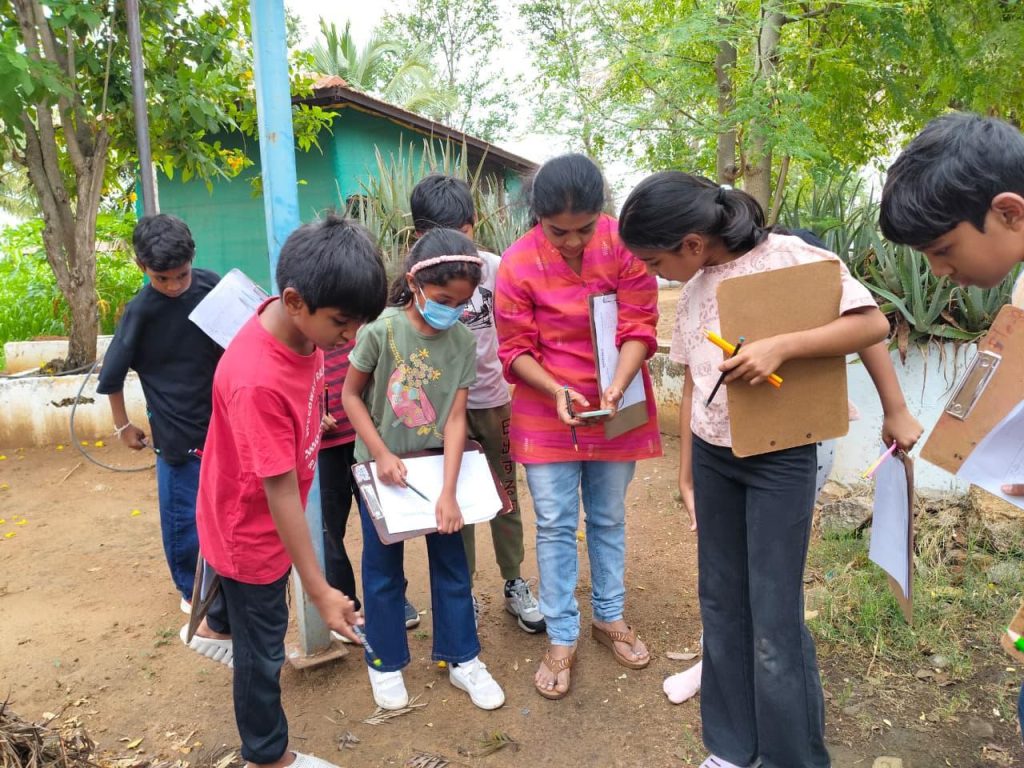
“Children come to biomimicry already full of questions about how animals solve problems,” notes Sandhya Rao, the Montessori educator leading the school’s biomimicry initiatives. “Our job is to help them slow down and observe properly before they start to design. The observation is where the real ideas come from.”
(Parents can explore the full scope of these student-led initiatives via the Blue Blocks innovation programme).
Choosing a school: What to look for
When touring schools, a glance at the equipment reveals less than asking a few direct questions: Who frames the problems: the child, the teacher, or the kit? What happens to a prototype that fails? Are projects documented so a child can track how their thinking evolved?
Families looking for a stem innovation school gachibowli will find that Blue Blocks operates its early-years programs at its Gachibowli campus. Here, the essential habits of innovation take root before children transition to the Tellapur campus for their advanced elementary and adolescent lab work.
Frequently Asked Questions
Is innovation education only for children who love science? No. Innovation draws on noticing, questioning, designing, and persisting. These traits matter just as much in writing, art, and social projects as they do in engineering. A child who is not drawn to robotics may still be a highly inventive thinker in other areas.
At what age should innovation learning begin? The habits behind innovation begin in the early years, long before formal STEM work. A young child who notices a mistake and corrects it, or keeps trying a difficult physical task, is already practicing them. Dedicated labs become useful later, once those foundational habits are established.
Does a focus on innovation take time away from academics? It does not have to. Well-designed projects require mathematics, science, reading, and writing, giving children a tangible reason to master them. The question to ask is whether a school’s projects deepen academic understanding or just sit beside it as a distracting extra activity.
How can parents encourage innovative thinking at home? Give children real problems and the time to work on them: fixing a wobbly chair, planning a small garden, or building something with household materials. When an attempt fails, ask what they noticed before offering a solution. Patience with an unfinished idea teaches a child far more than a quick fix.
The question worth carrying home: The next time a school shows you a finished project, ask to see the version that did not work. What a school does with its failed prototypes tells you far more about its approach to learning than anything sitting perfectly on display.